

Quick answer: Real Manchego is a pressed sheep’s milk cheese made only from Manchega sheep in La Mancha (Albacete, Ciudad Real, Cuenca and Toledo) and protected by a DOP. The longer it ages, the firmer, more golden and more piquant it gets: semicurado is mild and creamy, curado is nutty and caramelly, viejo is hard and sharp. Serve it at room temperature in thin triangles with membrillo, almonds and a dry sherry.
Manchego is Spain’s best-known cheese, and one of the most imitated. The name on a label does not guarantee the cheese: only Manchego with the Denominación de Origen Protegida (DOP) “Queso Manchego” is made from the milk of Manchega sheep inside the protected area, under the rules of a regulatory council. Everything else is a different cheese, however similar the name.
This guide explains what the DOP guarantees, how the ages differ, how to recognize the real thing, how to cut and serve it, what to pair it with and how to store it.
What makes Manchego, Manchego (the DOP)
The DOP’s official single document sets the essentials:
- Milk: exclusively from sheep of the Manchega breed, registered with the regulatory council and raised in the delimited zone. No milk from other species is allowed.
- Place: raising, milking, cheesemaking, pressing, salting and ripening all happen within the area: parts of the provinces of Albacete, Ciudad Real, Cuenca and Toledo, the natural region of La Mancha.
- Style: a pressed-curd cheese (pasta prensada), cylindrical with flat faces, between 0.4 and 4 kg.
- Ripening: minimum 30 days for cheeses up to 1.5 kg and 60 days for larger formats, maximum 2 years.
- Composition: at least 50% fat on dry matter, at most 2.3% salt.
- Rind and paste: a hard rind, pale yellow to dark brown, with the typical mold impressions: a woven-esparto (pleita) pattern on the side and a flower on the faces. The paste is firm and compact, from white to ivory-yellowish, with small, unevenly spread holes.
- Flavor: an intense, lasting milky aroma and a slightly acidic taste that becomes piquant in the most aged cheeses.
- Labeling: every cheese carries a numbered back label and a numbered casein plate issued by the regulatory council, plus the words “Denominación de Origen Protegida Queso Manchego”. The word “Artesano” indicates raw milk, and “queso de granja” (farm cheese) means an artisan dairy using only its own flock’s milk.
The plate and the label are your proof: you can verify real Manchego before you taste it.
Manchego ages: semicurado, curado and viejo
Manchego is sold by degree of ripening. The DOP sets the legal minimum and maximum (30 or 60 days up to 2 years) but the market uses four commonly understood stages. The month ranges below are widely used in the trade; producers draw the lines in slightly different places, so read the age on the label.
| Stage | Typical age | Texture | Flavor | Best used for |
|---|---|---|---|---|
| Fresco | A few weeks | Soft, moist, pale | Milky, fresh, slightly tangy | Rarely exported; salads and snacking in Spain |
| Semicurado | From about 3 weeks to roughly 3 to 4 months | Semi-firm, supple, buttery | Mild, milky, hint of toasted nuts | First-time tasting, sandwiches, melting, kids and crowds |
| Curado | About 3 to 6 months | Firmer, golden paste, small eyes | Nutty, caramel notes, more tang | The classic Manchego for boards and tapas |
| Viejo | About a year and up to the 2-year maximum | Hard, crumbly, may form crystals | Sharp, piquant, deep, long finish | Shaving, grating and slow tasting with strong wine |
Where does our cheese sit? Our Vega Mancha Manchego DOP aged 3 months has an ivory, semi-firm, supple paste with a buttery, milky sweetness and a gentle tang: the friendly face of Manchego and a good starting point. Our Vega Mancha Manchego DOP aged 6 months is firmer and more flavorful, the all-round Manchego for a board. Both come as a 1 lb wedge or as whole wheels of 3.5 lb and 7.5 lb.
Which age should you buy?
- New to Manchego? Start with the 3-month. It is mild and easy.
- Building a board? The 6-month is the usual choice: it slices cleanly and has enough character for wine.
- Cooking? The younger cheese melts more easily for grilled sandwiches and quesadillas.
- A cheese lover’s treat? Look for the oldest you can find; a viejo rewards slow tasting.
How to spot real Manchego
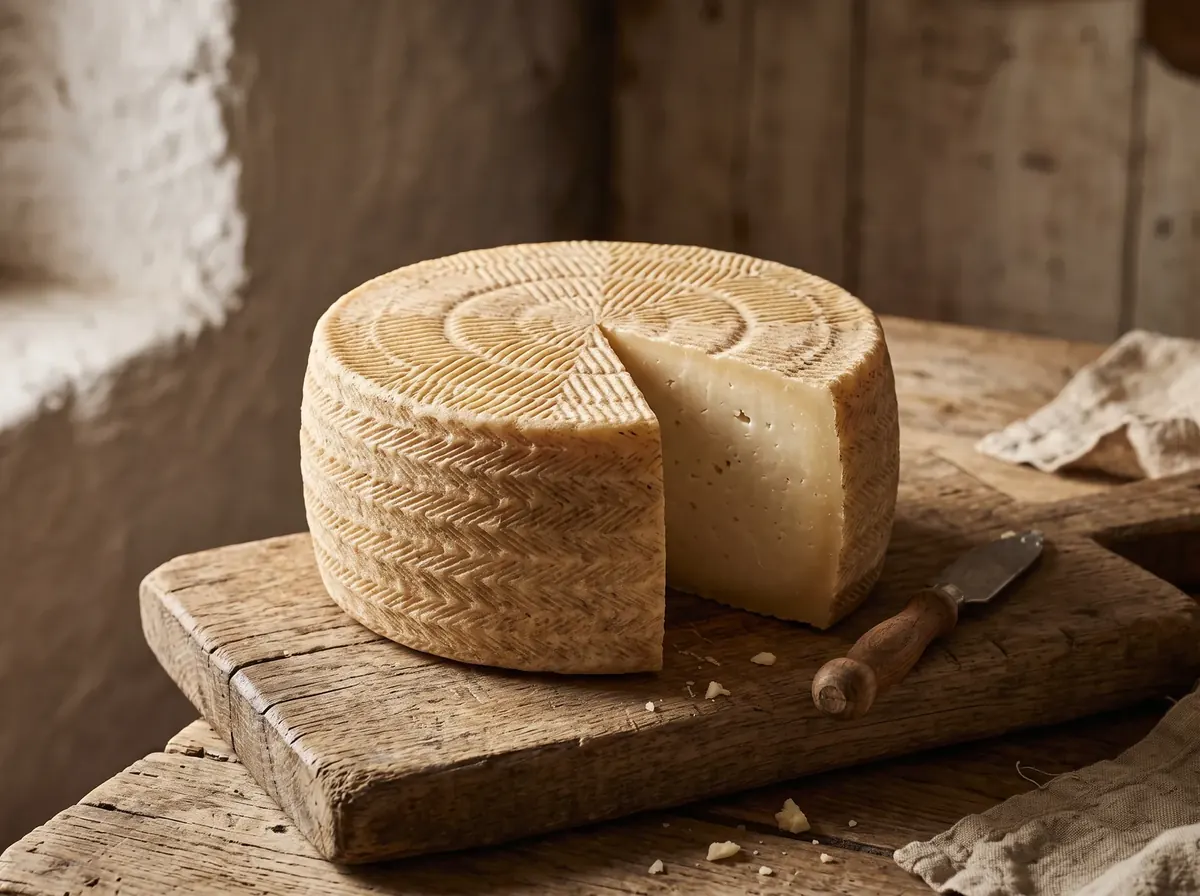
- Look for “Denominación de Origen Protegida Queso Manchego” on the label. “Manchego-style” or “Spanish cheese” is not the same thing.
- Check for the numbered casein plate and back label. They are issued by the regulatory council and cannot be reused.
- Read the milk. The DOP means sheep’s milk (Manchega breed). Cheeses made with cow’s milk can resemble Manchego but are not.
- Check the rind. The zigzag (pleita) pattern on the side and the flower on the faces come from the molds. The rind is not meant to be eaten.
- Look at the origin. La Mancha, Spain.
How to serve Manchego
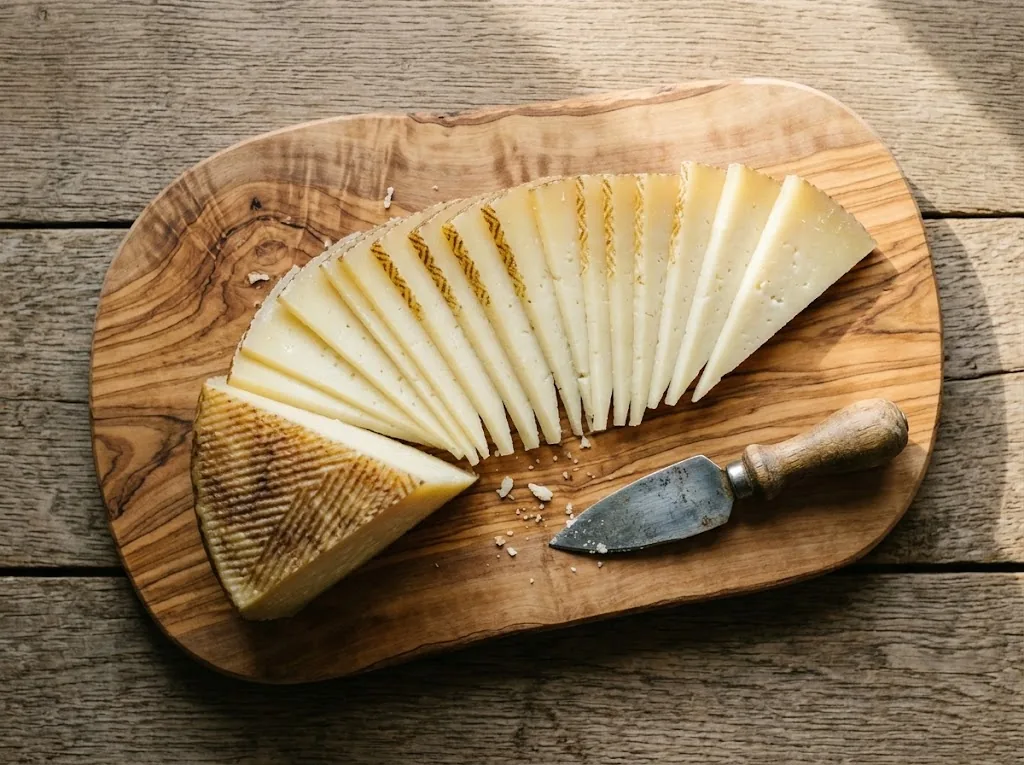
- Take it out of the fridge 30 to 60 minutes before serving. Cold cheese is muted; at room temperature its aroma and texture open up.
- Cut a wedge in thin triangles starting at the point, so each piece has paste from the center and edge. A whole wheel is cut like a pie, then each wedge is sliced from the tip.
- Leave the rind on while you serve. It is not eaten; discard it on the plate.
- Use a proper knife. A cheese knife or a sturdy, short-bladed knife helps with firm, aged paste.
- Cut only what you will serve. Re-wrap the rest promptly.
For aged wedges, thin shavings are better than chunky slices. For younger cheese, slightly thicker triangles show its creamy texture.
What to pair with Manchego
The classic Spanish partners are sweet, salty and nutty.
- Membrillo (quince paste): the traditional pairing. In Spain we put it on the cheese board by default. The sweetness and slight acidity offset the cheese’s saltiness. In Spain it is a standard on any cheese plate.
- Marcona almonds and walnuts: crunch and nutty depth.
- Honey: especially with curado and viejo.
- Jamón: Manchego beside Serrano or Ibérico is the unbeatable tapa.
- Olives and pickles: salty, briny counterpoints; browse Spanish olives and pickles.
- Olive oil: a few drops of a robust extra virgin, such as Palacio de los Olivos Picual, over aged Manchego is a treat.
- Bread: plain, toasted or rubbed with tomato.
| Wine | Works with | Why |
|---|---|---|
| Fino or manzanilla sherry | Semicurado, curado | Dry, saline, refreshing |
| Amontillado or oloroso sherry | Curado, viejo | Nutty depth matches aged paste |
| Rioja crianza (tempranillo) | Curado, viejo | Fruit and soft tannins |
| Cava brut | Semicurado, curado | Bubbles cut the richness |
| Albariño or young white | Semicurado | Crisp, fresh |
How to store Manchego
Keep it refrigerated, ideally at 35-45 °F (2-7 °C). Wrap the cut surface in wax paper or parchment rather than tight plastic, so the cheese can breathe, and re-wrap after every cut. Take it out of the fridge a while before serving. The rind keeps the paste protected, so keep it on until you are done. Our own Vega Mancha cheeses ship refrigerated.
Cooking with Manchego
Young Manchego melts well for toasted sandwiches, quesadillas and baked dishes. Aged Manchego is better grated over eggs, pasta or salads or shaved over vegetables. For a Spanish melting cheese from a different region, Galician Tetilla is a favorite. And for something different at the same table, try the Vega Sotuélamos truffled sheep’s milk cheese or a Majorero goat cheese. See all in our Spanish cheese category.
Frequently asked questions
What is Manchego cheese made from?
Manchego DOP is made only from the whole milk of Manchega sheep raised in the protected area of La Mancha. No milk from other animals is allowed. The cheese is pressed, salted and aged for at least 30 or 60 days depending on size, and up to 2 years.
What is the difference between semicurado, curado and viejo?
They describe the age. Semicurado (from a few weeks to about 3 to 4 months) is mild and supple. Curado (about 3 to 6 months) is firmer, nutty and tangier. Viejo (about a year or more) is hard, sharp and piquant. Exact cut-offs vary by producer, so check the age on the label.
Do you eat the rind of Manchego?
No. The rind of a Manchego is not meant to be eaten. Cut it off the wedge or leave it on the plate. It shows the characteristic mold impressions that mark a real Manchego.
Is Manchego the same as “Manchego-style” cheese?
No. Only cheese with the DOP “Queso Manchego” is made from Manchega sheep’s milk inside the protected area and carries the numbered casein plate. Cheeses sold as “Manchego-style” or generic “Spanish cheese” can be made with different milk or in other regions.
How long does Manchego last once cut?
Wrapped in wax or parchment paper and refrigerated at 35-45 °F, a cut wedge is at its best within about two weeks (our guideline). If the surface dries, trim a thin layer. Always check smell and appearance.
Bring home real Manchego
Choose the 3-month for an easy introduction or the 6-month for a board, as a wedge or a whole wheel. Add a few friends from the Spanish cheese shelf, some olives, and a slice of Serrano ham, and you have a Spanish table.