
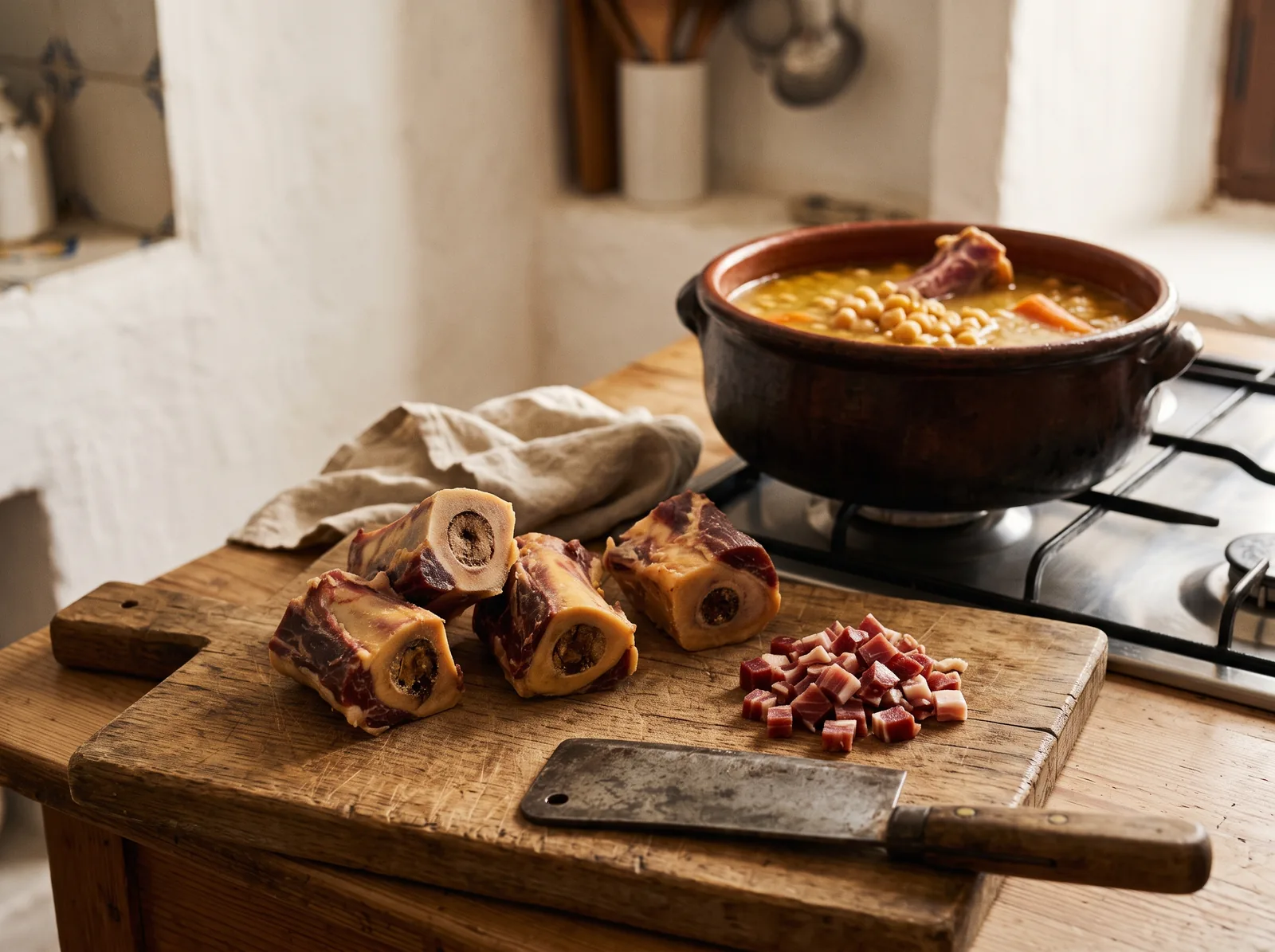
Quick answer: Do not throw it away. Take the last meat off in small dice (taquitos), have your butcher saw the bone into pieces of about 3 to 4 inches (8 to 10 cm), and freeze them in bags. Then simmer a piece in cold water for 1.5 to 2 hours for broth, or drop it into lentils, white beans or a puchero. Cut away anything rancid or yellow first, salt only at the end, and never give the bone to a dog.
In a Spanish home, a jamón is not finished when the last slice is gone. The bone is the second half of the ham. It gets cut up, bagged and put in the freezer, and it comes out all winter long: a piece in the lentils on a Tuesday, another in the pot for Sunday’s puchero. That is how we have always used it, as the quiet seasoning of platos de cuchara, the spoon dishes that make up half of Spanish home cooking. It is not a trend and it needs no special equipment.
This guide explains how to know your jamón is finished, what to trim off the bone, how to cut and freeze it safely, how to make a plain Spanish broth, which traditional dishes really use a ham bone (and which do not), what to do with the scraps, and how a jamón bone differs from the American ham hock.
When is a jamón really finished?
There is no exact day. A leg kept well lasts weeks, and a Spanish consumer guide puts an opened one at about a month and a half in good conditions (see our guide to storing a whole ham for the details). What matters is what the leg looks like.
The white-bone test
You are finished when the bone shows white and clean on the faces you have carved, and the meat that remains no longer comes off in slices, only in small pieces. Spanish carvers stop slicing when they can see clean bone.
The last stretch: puntilla, jarrete and taquitos
Before you retire the leg, take the last of it:
- Use the short pointed knife (puntilla) to cut around the hip bone (coxal) and the femur, and to free the thin bones toward the narrow end (the tibia and the finer fibula, together the caña).
- Work the jarrete, the fibrous, tasty meat toward the narrow end. It is tough to slice but wonderful in soups and croquetas.
- Dice everything you cannot slice into taquitos. Our step-by-step carving guide shows where the bone gets in the way.
Hard, dry taquitos are for cooking, not for eating raw. More on that below.
What do you remove before keeping the bone?
A bone from a well-stored leg needs little, but look at it properly before it goes in a bag.
- Anything rancid or yellowish. Spanish recipes say to clean off dirt and any rancid or yellowish parts before cooking. If the bone smells sharp or sour, feels slimy or has fuzzy mold, throw it away.
- Yellow fat. Dry, yellowed fat turns bitter; discard it.
- The odd white speck. White dots in the meat are usually harmless tyrosine crystals (see the storage guide). If anything moves, or you are unsure about a patch, cut it off. If you are unsure about the whole bone, do not use it.
Fat you keep
The clean white fat under the rind is worth saving. Melt it slowly, store it in a closed jar in the fridge and add a teaspoon to your frying oil, a stew or fried potatoes. It is an old kitchen trick, and a little goes a long way.
The rind
The rind (corteza) is a good addition to a pot of lentils. Spanish cooks render a little of its fat in the pan for the sofrito and let the rind cook with the legumes. Take it out before serving.
How do you cut a ham bone?
A leg bone is long and dense, and it will not fit in a pot whole. In Spain the usual answer is to ask the butcher, who cuts it with a power saw in a couple of minutes.
Ask your butcher
This is the easy way. Bring the bone clean and wrapped, and ask for either of these:
- 3 or 4 manageable pieces, or
- Rounds of about 3 to 4 inches (8 to 10 cm), the size at which Spanish shops sell packed bone for broth.
In the United States, try a supermarket with a full-service meat counter, or a butcher shop with a band saw. Not every counter will say yes, so ask politely and early, not at the busiest hour.
How do you store the bone (and the broth)?
Once you have your pieces:
- Wipe them clean and let them dry.
- Bag them in freezer bags, vacuum-sealed if you have a machine, with as little air as possible.
- Label the date and freeze.
- Collect bones if you like, until you have enough for a full pot.
How long will they keep? A freezer holds food safely, but flavor fades with time. We use ours within a few months, and our advice is to do the same. We do not have a precise figure we can stand behind, so we will not invent one.
A note so our guides do not seem to contradict each other: we say not to freeze a whole bone-in leg. That is about the leg, with its meat. A bone that has already been taken off the ham and cut into pieces is a different thing and freezes well.
The broth. Cool it quickly. According to one producer’s recipe, it keeps four to five days in the fridge and three to four months in the freezer. Freeze it in ice cube trays for small portions or in tubs for a big pot. When cold, it may set to a light jelly. That is normal.
How do you make a basic ham-bone broth?
Spanish recipes for ham broth do not agree on every number, so treat the table below as a range and adjust to your taste. They do agree on the method: start in cold water, skim, keep it gentle and salt last.
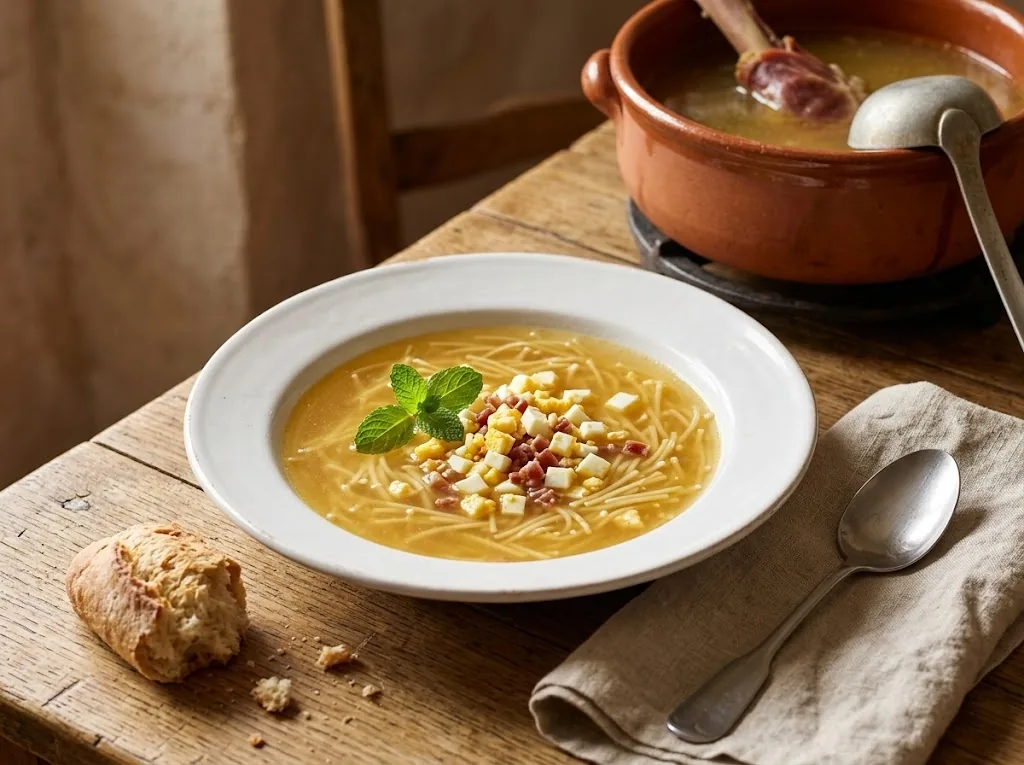
Here is our basic version for four people.
- Rinse the pieces well under cold water. If the bone comes from a very salty ham, you can blanch it first: cover with water, boil for about 3 minutes, drain and throw that water away. Some Spanish recipes do this; others simply rinse. It is optional.
- Start in cold water. Put about 2.2 lb (1 kg) of bone in a large pot and cover with about 2 quarts (2 liters) of cold water. That is roughly the proportion in a published Spanish recipe, which uses 1.5 kg of bone to 3 liters.
- Add the vegetables if you want a broth to drink or for noodles: an onion, a leek, a carrot, a celery stick, a few garlic cloves, a bay leaf. Leave them out if the broth is only the base for a stew.
- Bring it to a gentle simmer and skim the foam from the surface.
- Cook for 1.5 to 2 hours at a very low simmer with the lid on. A hard boil churns the fat into the liquid and makes the broth cloudy.
- Season at the end. Taste first. A ham bone and its fat already salt the pot, so most broths need very little or none.
- Strain, cool and skim the fat. Chill it and the fat rises and sets on top; lift it off.
| Approach | Bone | Water | Time | Notes |
|---|---|---|---|---|
| Spanish home recipe (serrano bone) | 1.5 kg | 3 liters, cold | 1.5 to 2 hours, low | Skim; clean off rancid or yellow parts |
| Blanched version (US producer) | Bones of one leg, in pieces | About 3.3 liters | 2 hours, covered | Boil the bones 3 minutes first and discard the water; salt at the end |
| Spanish shop recipe, noodle soup | 2 bones, plus ibérico shavings | 2.5 liters | 1 hour | Thin noodles for 5 minutes, hard-boiled egg |
Roasting the bone first is something some modern recipes do, for a darker, longer broth. It is optional and not the traditional route for a cocido or a lentil pot. If you try it, you are making a different broth.
Which Spanish dishes use a ham bone?
Here is where many guides go wrong: not every Spanish classic uses a ham bone. This is what published Spanish recipes say. A Spanish recipe says “a bone” and leaves the rest to the cook; one or two of your cut pieces is a sensible start for a pot for four.
Dishes that use it
| Dish | Region | The ham bone | Notes |
|---|---|---|---|
| Cocido madrileño | Madrid | In many versions, not all. One published recipe uses one bone for four people with 300 g of chickpeas; others use a punta (the tip) or codillos de jamón | Meats start in cold water, are skimmed and cook long and slow |
| Puchero andaluz | Andalusia | “Hueso o punta de jamón”, about one piece for three people, with a beef knee bone and salted pork spine | From 1.5 to 3 hours depending on the pot |
| Caldo gallego | Galicia | A ham bone or a lacón bone (never rancid), plus a beef bone | The bone comes out before the potatoes go in; about 3 hours in all |
| Lentejas | Alto Aragón, Castile | One bone for 400 to 500 g of lentils | Goes in with the lentils; sofrito added later |
| Alubias blancas | All over Spain | One bone for 500 g of beans, for four | Beans soaked overnight, “scared” with cold water, 1.5 to 2 hours; salt last |
| Sopa de picadillo | Andalusia | Two bones in the broth for six, with hen and beef bones; the taquitos of jamón go in with the rice | Broth 2 to 3 hours. Some versions use only the tip |
| Escudella i carn d’olla | Catalonia | “Hueso o punta de jamón” in a recipe for eight | Appears in several Catalan recipes |
Our lentejas estofadas recipe lets you cook a piece of ham bone with the lentils and chorizo.
Dishes that traditionally do NOT use it
These are worth knowing, because the bone is often added to them in modern recipes and written up as if it were classic:
- Cocido montañés (Cantabria). The compango is chorizo, morcilla, adobo ribs and pork belly. No ham bone.
- Fabada asturiana (Asturias). The compango is chorizo, morcilla, lacón and tocino. A few recipes add a ham bone, but it is not part of the traditional pot.
- Potaje de vigilia (Andalusia) and garbanzos con espinacas. A meatless Lenten dish. Modern versions with ham bone exist, but that is not the traditional one.
Use your bone in these if you like, but call it your own way of making it.
What do you do with the scraps and taquitos?
The little cubes from near the bone are some of the most flavorful ham in the leg. Cook them: hard, dry pieces are better in a pot than on a plate.
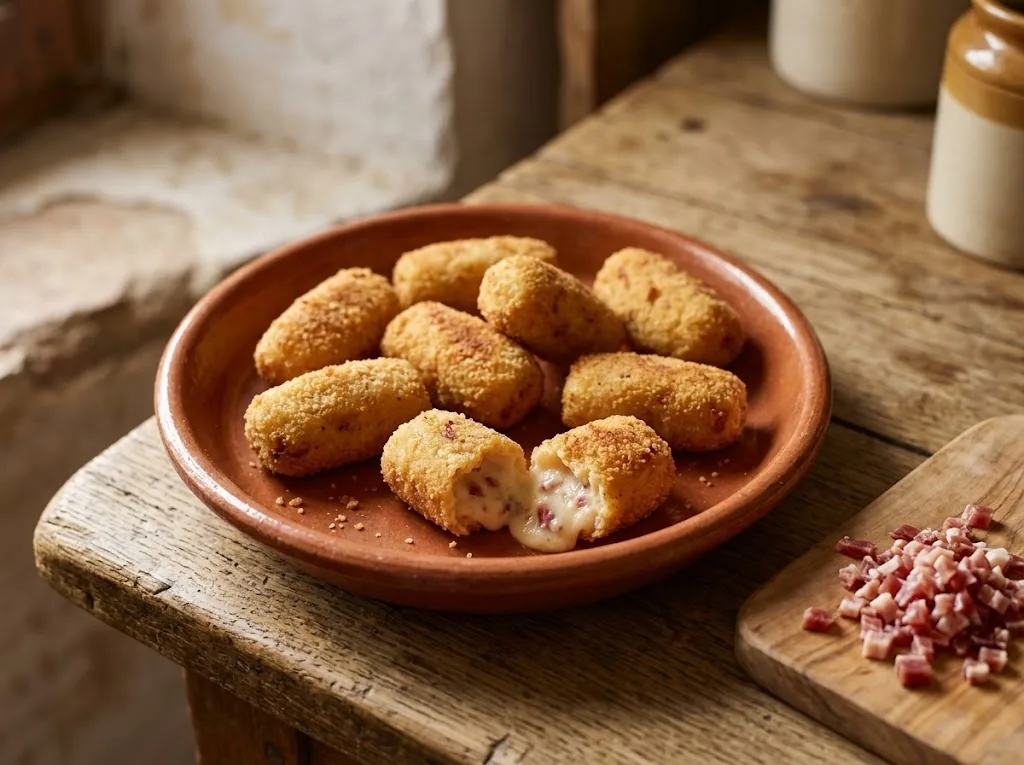
- Croquetas de jamón. Chop the scraps and mix them into a very thick béchamel.
- Eggs. Scrambled eggs with taquitos, or a tortilla.
- Lentils, beans and peas. A handful of taquitos at the end brings a pot to life.
- Sopa de picadillo. Diced jamón goes in the soup with the rice.
- Salmorejo. A scatter of diced ham on top, with hard-boiled egg.
- The fat. A spoonful of rendered white fat in frying oil or a stew.
What mistakes should you avoid?
- Too much salt. The bone and its fat salt the dish. Rinse the bone, start in cold water, taste and add salt at the end.
- Boiling hard. It makes the broth cloudy and greasy. Keep it at a gentle simmer.
- A rancid bone or yellow fat. One bad piece can spoil the whole pot. If in doubt, throw it out.
- Leaving it in too long. Recipes give 1.5 to 2 hours for broth, and caldo gallego takes the bone out before the potatoes go in.
- The wrong tools. No cleaver, no hatchet and no kitchen knife.
- Reusing it again and again. We do not reuse a bone for a second broth: by then the flavor is thin. That is a house rule, not a rule from a source.
- Giving it to the dog. See the next section.
Can dogs have the ham bone?
No. Cooked bones can splinter (a Spanish pet-food guide notes that cooked ham bones can be soft enough to break), and the FDA warns that sharp pieces of bone can injure a dog’s mouth, esophagus and stomach. Cured ham bones are also salty. Veterinary opinion differs on exactly how cooked bones do harm, but none of the sources we read recommends them. Put the bones where the dog cannot reach them, and call your vet if your dog has swallowed one.
Ham bone vs. ham hock: what is the difference?
If you search for American recipes, you will meet both words.
- Ham bone comes from the upper part of the leg. In the United States it is sometimes smoked, sometimes not.
- Ham hock is the lower part of the leg. It is almost always cured and smoked, with more connective tissue and fat, and it is a stronger flavor than a bone.
A jamón serrano or ibérico bone is dry-cured, not smoked. So it gives your pot a clean, savory, cured taste, not a smoky one, and it will be less gelatinous than a hock. It can stand in for a hock in bean and lentil soups, but expect a different, cleaner flavor. Spanish pots get their smoke from chorizo and pimentón (paprika), not from the bone.
Frequently asked questions
What do you do with the bone of a jamón when it is finished?
Keep it. Have your butcher cut it into pieces of 3 to 4 inches (8 to 10 cm), freeze them, and use a piece for broth or in lentils, beans or a puchero. Simmer it in cold water for 1.5 to 2 hours.
Can you freeze a jamón bone, and for how long?
Yes. Cut it, bag it, ideally vacuum-sealed, and freeze it. A freezer keeps food safe, but flavor fades, so we use ours within a few months.
Do you have to soak or blanch a ham bone to remove the salt?
Not always. Rinse it well and start in cold water, skimming as it comes to a simmer. If the bone is very salty, you can boil it for about 3 minutes and discard that water. Either way, add salt at the end.
Can I use the same bone twice?
We do not. After a long simmer, most of what the bone can give is already in the pot. This is our house advice, not a rule from a source.
Can my dog have the ham bone?
No. Cooked bones can splinter, and the FDA warns that sharp pieces of bone can injure a dog’s mouth, esophagus and stomach. Cured ham bones are salty as well.
Is a jamón bone the same as a ham hock?
No. A hock is the lower leg and is usually smoked; a jamón bone is dry-cured and not smoked. They can stand in for each other in bean soups, but the flavor is not the same.
Ready for your next jamón?
A bone-in leg gives you weeks of jamón and then months of soups. Browse our Spanish hams to find the one that suits your table, and before you start, read how to store it and carve it.