
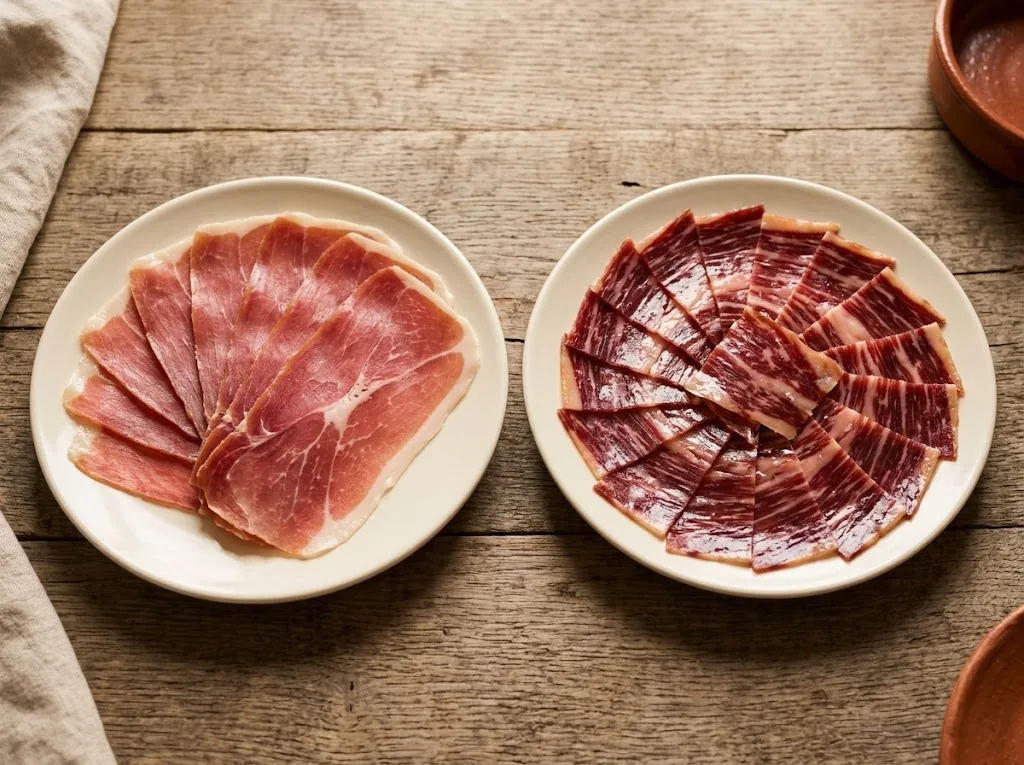
Quick answer: Serrano comes from white-breed pigs and is cured for roughly a year or more. Ibérico comes from the native Ibérico pig (at least 50% by law) and is cured for two to four years. Bellota is not a third type of ham: it is the top diet tier of Ibérico, where the pigs finish on acorns. A black seal means 100% Ibérico de bellota. Italian prosciutto, such as Parma, is also made from white-breed pigs, cured with sea salt only for at least 14 months.
Serrano and Ibérico are different pigs; bellota is a different diet. In Spain, the seal is how we tell them apart. That is the whole puzzle, and most of the confusion online comes from treating the three words as three equal categories. “Serrano” names a type of ham from white-breed pigs. “Ibérico” names ham from Ibérico-breed pigs. “Bellota” (“acorn”) describes how an Ibérico pig was fed, and it only applies inside the Ibérico family.
Below you will find the legal definitions from Spain’s Real Decreto 4/2014, the color seals explained, a side-by-side table and a simple way to choose.
The three words, in one minute
- Jamón Serrano: ham from white-breed pigs, salted and dry-cured for months in the mountain air that gave it its name (sierra means mountain range). Firm, savory, lean. It is the everyday ham of Spain.
- Jamón Ibérico: ham from pigs of the Ibérico breed (or crosses with at least 50% Ibérico blood). Darker meat, more fat, longer curing, and fat that melts at room temperature.
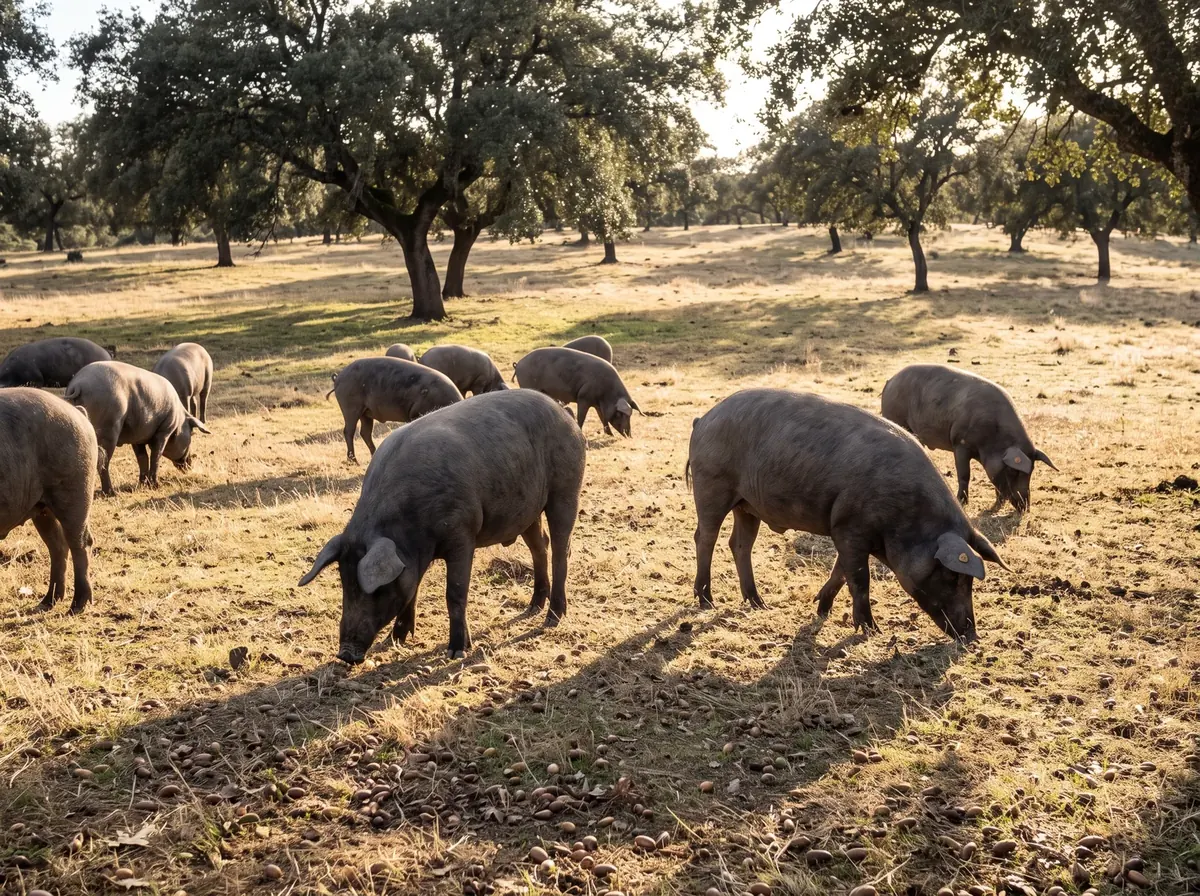
- Bellota: the highest feeding tier of Ibérico. The pigs live in the dehesa (open oak woodland) and finish their last months on acorns and grass, in a period called the montanera.
The colored seals under Real Decreto 4/2014
Spain regulates Ibérico ham through the Norma de calidad del jamón, la paleta y la caña de lomo ibéricos (Real Decreto 4/2014). Article 9.3 assigns a colored seal to each category of ham and shoulder. The seal tells you diet and breed in a single glance.
| Seal color | Official denomination | Breed | Feeding | Min. age at slaughter | Minimum curing (ham) |
|---|---|---|---|---|---|
| Black | De bellota 100% ibérico | 100% Ibérico (both parents 100% Ibérico) | Acorns, grass and dehesa resources only, no supplementary feed | 14 months | 600 days (under 7 kg) / 730 days (7 kg or more) |
| Red | De bellota ibérico | At least 50% Ibérico (50% or 75%) | Same montanera rules as black | 14 months | Same as above |
| Green | De cebo de campo ibérico | At least 50% Ibérico | Outdoor farming, feed based on cereals and legumes, plus acorns and pasture where available | 12 months | Same as above |
| White | De cebo ibérico | At least 50% Ibérico | Cereal and legume feed on an intensive farm | 10 months | Same as above |
A few details that matter:
- Curing is counted from the day salting begins. Minimum curing is 600 days for hams under 7 kg and 730 days for hams of 7 kg or more. For a shoulder (paleta) the minimum is 365 days.
- Minimum weights at the end of curing: 5.75 kg for a 100% Ibérico ham and 7 kg for other Ibérico hams. A 100% Ibérico paleta must weigh at least 3.7 kg and other Ibérico shoulders 4 kg.
- The percentage of Ibérico breed must appear on the label for anything that is not 100% Ibérico.
- Montanera rules (bellota): pigs enter the montanera between October 1 and December 15 at an average of 92 to 115 kg, must gain at least 46 kg on the acorn diet and are slaughtered between December 15 and March 31. The norm also caps the number of animals per hectare according to how much tree cover the pasture has.
- Cebo de campo: a minimum of 60 days on the farm before slaughter, with space in the intensive outdoor system of 100 m² per animal over 110 kg live weight, as written in the consolidated text.
- Cebo: intensive farming with at least 2 m² of free floor per animal over 110 kg.
The norm also sets the label rules. The words dehesa and montanera (and acorn imagery) are reserved for the “de bellota” category, and pata negra may only be used for “de bellota 100% ibérico”. The terms recebo and ibérico puro are banned.
Side-by-side comparison
| Jamón Serrano | Ibérico de cebo / cebo de campo | Ibérico de bellota | |
|---|---|---|---|
| Pig | White breeds (Landrace, Large White, Duroc crosses) | Ibérico, 50% to 100% by label | Ibérico, 50% to 100% by label (black seal = 100%) |
| Diet | Cereal-based feed | Cereal and legume feed; cebo de campo also gets outdoor pasture and acorns where available | Acorns and grass in the dehesa (montanera) |
| Typical curing | About 9 to 15+ months in common trade tiers (bodega, reserva, gran reserva) | Minimum 600 or 730 days; premium houses go to 3 years or more | Minimum 600 or 730 days; premium houses often go to 3 to 4 years or more |
| Meat and fat | Lean, firm, rose-pink | Deeper red, more marbling | Deep red, heavy marbling, fat melts at room temperature |
| Flavor | Salty-savory, clean | Savory, nutty, more direct | Sweet, nutty, long finish |
| Price per lb of whole leg (our catalog, Oct 2026) | ~$16 to ~$17 | ~$31 to ~$37 | ~$68 to ~$109 |
| Best for | Sandwiches, boards, cooking, big gatherings | Everyday carving, family celebrations | Centerpiece, gifts, tasting on its own |
The Serrano tiers are market conventions rather than one universal legal definition, and some Serrano producers cure longer. The Ibérico minimums are the legal floor under Real Decreto 4/2014.
Why the fat tastes different
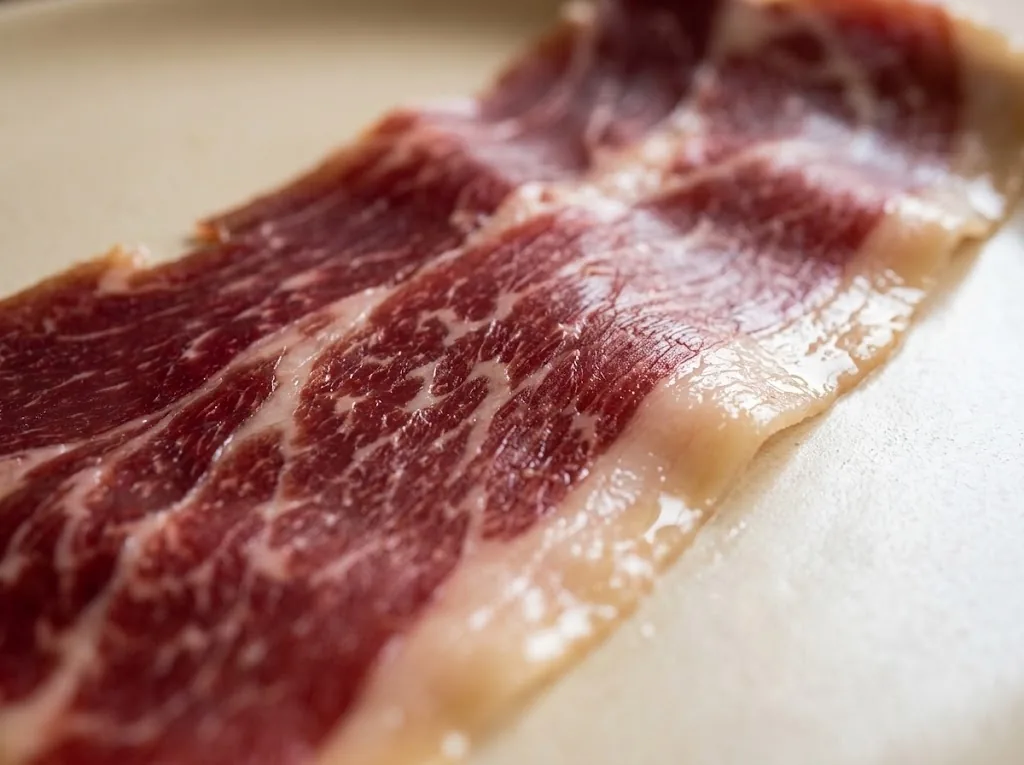
Ibérico fat is rich in oleic acid, the same type of fat found in olive oil. A frequently cited Spanish consumer reference notes that this fat begins to melt around 14 °C (57 °F), which is why we serve Ibérico at room temperature, around 68-72 °F, and eat it in slices with a little fat attached. Acorn-fed pigs accumulate more of it, and that is why bellota tastes sweeter and “melts” on the tongue.
Serrano is leaner and firmer. It carves into wide, tidy slices and stands up to bread, melon, eggs and cooking, which is how most of Spain eats it.
What about “pata negra”?
In Spain, pata negra (“black hoof”) is legally reserved for the black-seal category, bellota 100% Ibérico. The hoof color is not proof. Some Ibérico pigs have dark hooves, some do not, and white-breed pigs can have dark hooves too. When you shop, ignore the hoof and read the seal and the label wording: “de bellota”, “100% ibérico” and the percentage of Ibérico breed. Outside Spain, sellers sometimes use “pata negra” as a generic marketing term, so the label wording is what protects you.
Denominaciones de Origen (DOP)
Separate from the colored seals, Spain has four protected designations of origin (DOP) for Ibérico ham, each tied to a geography: Guijuelo (Salamanca), Dehesa de Extremadura, Jabugo (Huelva, formerly known as Jamón de Huelva) and Los Pedroches (Córdoba). A DOP tells you where the pig was raised and the ham cured. The color seal tells you diet and breed. A ham can have both. Some excellent hams carry only the seal, and that is fine: the seal is already a legal guarantee.
Serrano ham vs prosciutto and Parma ham
Prosciutto is simply Italian for ham: prosciutto crudo is the cured kind and prosciutto cotto the cooked one. When people compare serrano ham vs prosciutto, they usually mean Prosciutto di Parma or San Daniele, Italy’s best-known protected (PDO) hams. The idea is the same as jamón serrano, the hind leg of a white-breed pig, salted and air-dried, but the rules and the result are different.
| Jamón Serrano | Prosciutto di Parma (PDO) | Jamón Ibérico de bellota | |
|---|---|---|---|
| Pig | White breeds | Heavy white pigs (Italian Large White, Landrace, Duroc), at least 9 months old, born and raised in 11 regions of northern and central Italy | Ibérico, 50% to 100% by label (black seal = 100%), finished on acorns |
| Where it is cured | Across Spain | Only in a defined area of the province of Parma | Spain; four DOPs: Guijuelo, Jabugo, Dehesa de Extremadura and Los Pedroches |
| Ingredients | Salt; many also add a curing salt such as potassium nitrate (E-252) | Sea salt only, no other additives | Salt, often with a curing salt too (our Cinco Jotas and Beher labels list E-252) |
| Minimum curing | No single legal minimum; trade tiers run about 9 to 15+ months (ours: 15) | 14 months | 600 or 730 days by law; premium houses 3 years or more |
| Shape | Hoof on in Spain (removed for the US) | Trotter removed, rounded shape | Hoof on in Spain (removed for the US) |
| Texture and flavor | Firm, drier, savory | Soft, moist, delicate and not particularly salty | Marbled, nutty, sweet; the fat melts |
| How it is served | Hand-carved from the leg, or machine-sliced | Usually machine-sliced, wide and paper-thin | Hand-carved in small, thin slices |
Serrano or Parma? Parma is milder and silkier: its own specification describes it as delicate and not particularly salty, and it is cured with nothing but sea salt. That is why it melts into pasta and wraps melon so well. Serrano is firmer and more savory, with more chew and a drier finish; Spaniards eat it on bread with tomato and olive oil, in croquetas and with eggs. They swap well in most recipes: if a recipe calls for prosciutto, a good serrano works, sliced as thin as you can.
Ibérico ham vs prosciutto. This is not a close comparison. Ibérico comes from a different breed, a native Spanish pig that stores fat inside the muscle, and bellota adds a diet of acorns in the dehesa. The cure is longer too: by law at least 600 to 730 days, against 14 months for Parma, and three years or more at houses like Cinco Jotas. The result is darker meat, visible marbling and fat that melts at room temperature, at a higher price for the same reasons. Serve it on its own, at room temperature, rather than cooked.
How to choose
- For sandwiches, boards and cooking, buy Serrano. A Reserva-level Serrano like our Cortijo de Canata Serrano Reserva, 15-17 lb is cured for 15 months and gives you the classic firm bite at the lowest price per pound.
- For the best value in Ibérico, buy cebo de campo. The Beher 100% Ibérico cebo de campo ham is a green-seal leg cured for 36 months or more, with real Ibérico character.
- For a centerpiece or a gift, buy bellota. The Beher Ibérico de bellota and the Cinco Jotas 100% Ibérico de bellota are black-seal legs cured for years.
- Not ready for a whole leg? Taste first with hand-carved Ibérico pouches.
If you are still deciding on size and format, our guide on how to buy a whole Spanish ham covers servings and price per pound in detail.
Frequently asked questions
Is Ibérico ham better than Serrano?
Ibérico is richer, more marbled and more expensive, but better depends on use. Serrano is ideal for sandwiches, cooking and large gatherings. Ibérico, especially bellota, is the ham to serve on its own. Spaniards eat both, for different moments.
What does bellota mean on a ham?
Bellota means acorn. A “de bellota” ham comes from an Ibérico pig that spent its final months in the dehesa eating acorns and grass, with no supplementary feed, during the montanera. It is the top feeding tier under Real Decreto 4/2014.
What do the black, red, green and white labels mean?
They are the legal seals for Ibérico ham. Black is bellota 100% Ibérico, red is bellota Ibérico (at least 50% Ibérico breed), green is cebo de campo Ibérico and white is cebo Ibérico. The seal tells you the pig’s diet and breed.
How long is Ibérico ham cured?
By law, a ham of 7 kg or more is cured for at least 730 days (two years), a ham under 7 kg for at least 600 days and a shoulder for at least 365 days. Many premium houses cure three years or longer. Serrano is usually cured for about a year to 15 months or more.
Is pata negra the same as bellota?
In Spain, “pata negra” may only be used for bellota 100% Ibérico, the black-seal category. So all legitimate pata negra is bellota, but not all bellota is pata negra: a red-seal bellota ham is acorn-fed but less than 100% Ibérico.
Is serrano ham the same as prosciutto?
No, though they are close cousins. Both are cured hind legs of white-breed pigs. Serrano is Spanish, firmer and more savory, and keeps the hoof in Spain (legs sold in the US come without it). Prosciutto di Parma is Italian, softer and milder, sold without the trotter, and cured with sea salt only for at least 14 months.
Which is better, serrano ham or Parma ham?
Neither is better; they are different. Parma ham is milder and silkier, and Serrano is firmer with a deeper, savory flavor. Taste them side by side: a 15-month Serrano next to a Parma of similar age shows the difference at once.
Can I use serrano ham instead of prosciutto?
Yes. In almost any recipe that calls for prosciutto, such as melon, figs, pasta, asparagus wraps or pizza after it comes out of the oven, thinly sliced serrano works. Expect a slightly firmer, more intense bite.
Taste the difference
See all our Spanish hams, or go straight to the Ibérico de bellota hams, Ibérico de cebo de campo hams and Serrano hams. Every leg ships whole and bone-in, ready for a stand and a long knife. Not sure which to pick? Tell us your guest count and budget and we will point you to the right one.