
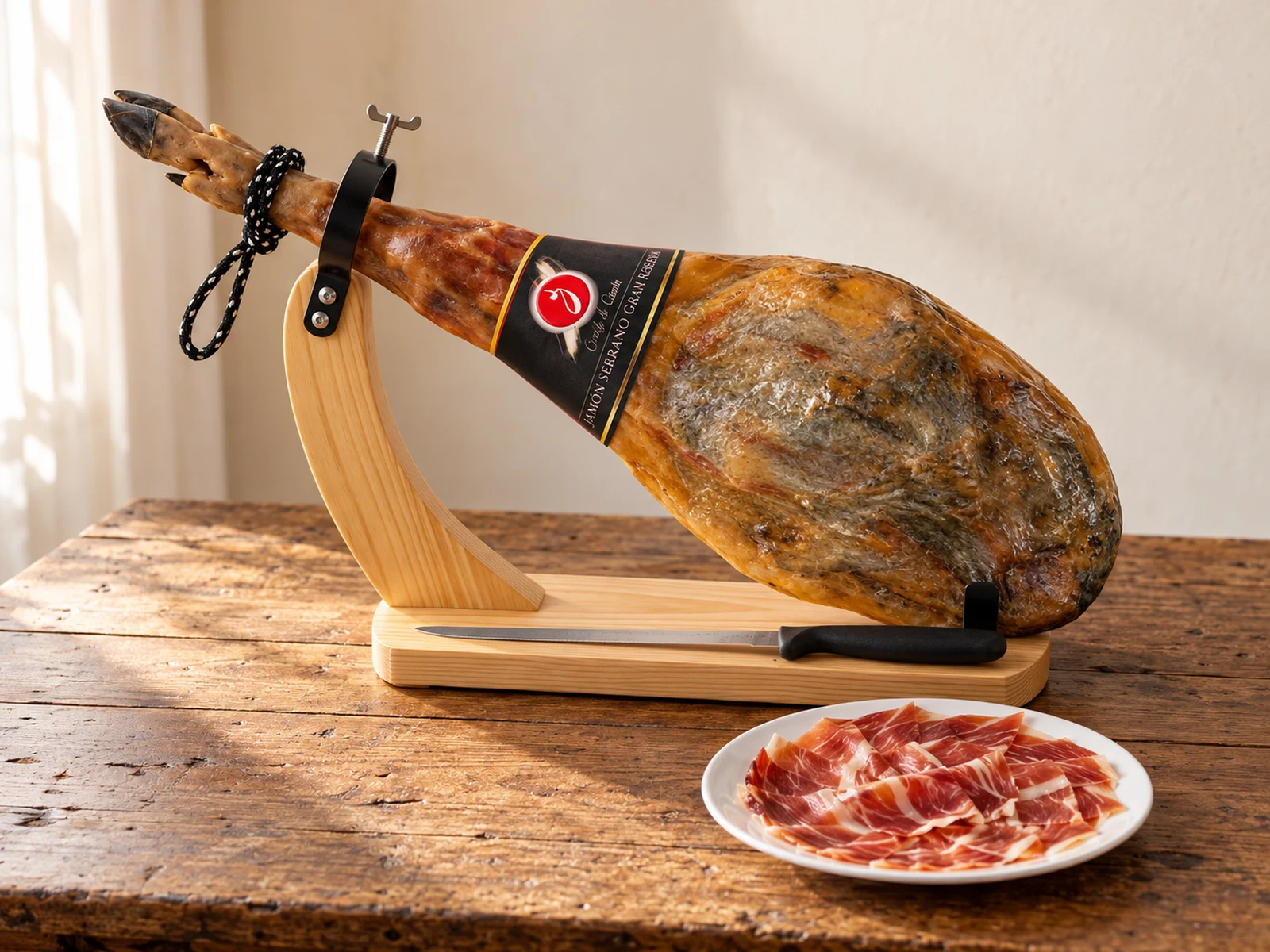
Quick answer: No. Jamón, paleta, chorizo, salchichón, lomo and any other pork product bought in Spain cannot be brought into the United States by a traveler, even if it is vacuum-packed or has the shop’s export label. It is taken away at the airport. Hard cured cheese, olive oil, tinned fish and sweets like turrón are generally fine if you declare them. And if what you want is Spanish ham on your counter, the legal route is a commercial importer, which is how ours gets here.
You finish a week in Spain, you have eaten more jamón than you planned, and the last day you stand in front of a shop window with a leg hanging in it. It looks like a perfect souvenir. It is not one you can take home. Here is what passes through US customs, what does not, and what to do instead.
Can you bring jamón into the US from Spain?
No, not in your suitcase and not in your carry-on. This covers jamón serrano, jamón ibérico, paleta (the front leg), chorizo, salchichón, lomo, morcilla and any other cured product made from pork. It makes no difference if it is sealed in vacuum plastic, in a nice box, or sold to you with an export sticker by the shop. The shop can sell it to you; that does not mean the United States will let you in with it.
The same applies to Spanish ham bought at the airport, in a duty-free store or in a market: the label of the shop is not an import permit.
What can you bring back from Spain?
Anything of animal origin has to be declared on the customs form, including cheese and a sealed tin of fish. Declaring is not a favor you do the officer, it is what keeps you out of trouble. Rules also change when there are animal disease outbreaks, so before you fly, check the travelers page of USDA APHIS (the Animal and Plant Health Inspection Service), which is the authority that decides this.
| Product | In your suitcase? | What we do |
|---|---|---|
| Jamón or paleta, whole | No | Whole bone-in hams, shipped from Florida across the US except Alaska and Hawaii |
| Jamón, sliced | No | Hand-carved slices: Florida only (they travel cold) |
| Chorizo, salchichón, lomo | No | Whole, unsliced embutidos, shipped across the US except Alaska and Hawaii |
| Hard cured cheese (Manchego, for instance) | Yes, declared | Manchego DOP: Florida only (cheese travels cold) |
| Spreadable or soft, flowing cheese | No | |
| Olive oil | Yes, declared | Extra virgin olive oil, shipped across the US except Alaska and Hawaii |
| Tinned fish (for personal use) | Yes, declared | Tinned fish, shipped across the US except Alaska and Hawaii |
| Turrón, chocolate and sweets without meat | Generally yes, declared | Turrón & sweets, shipped across the US except Alaska and Hawaii |
| Fresh fruit and vegetables | No |
Two notes on that table. A turrón or a sweet that contains egg or dairy is the one to double-check before you pack it: check the APHIS page or ask at the airport rather than assuming. And a solid, aged wedge of Manchego is the cheese that travels well; anything creamy or spreadable does not.
What happens if you try?
Whatever you declare that is not allowed stays at the port of entry, and that is the end of it: no fine, you lose the ham. Whatever you do not declare is seized if they find it, and then you can be given a civil penalty on top.
My advice is the boring one: if you are not sure, declare it. It costs you a minute in the customs line and spares you the worst part of a bad trip home.
What can you bring back from Spain that does pass?
A good suitcase from Spain is full, and most of it is allowed. For this you do not need to hide anything:
- Olive oil. The easy one. Wrap the bottle well; a 500 ml bottle in clothes is plenty.
- A wedge of hard cured cheese such as Manchego, declared.
- Turrón, chocolate and marzipan. The classic Christmas souvenir. Turrón de Jijona is the soft one and turrón de Alicante the hard one.
- Tins of fish and shellfish for personal use: sardines, mussels, cockles, zamburiñas.
- Things that are not food. A hand-painted ceramic plate from Talavera, a fan, an espadrille, a carved olive-wood spoon, a ham knife with its stand (the knife goes in checked luggage).
Missing the jamón you ate in Spain? We send it from Florida
The ham that cannot be carried in a suitcase can arrive by the legal door. A licensed importer brings it in through the official commercial channel, with its paperwork, and we send it from Florida. Whole hams, whole unsliced embutidos, oil, tins and turrón go to anywhere in the US except Alaska and Hawaii. Anything that has to travel cold, meaning sliced ham, cheese and the Christmas boxes, goes to Florida addresses only for now. Orders ship in 1 to 2 business days (see the shipping policy). If you are not sure where to start:
- For a first whole ham: the Serrano Ham Starter Kit with Stand & Knife ($289) has the leg, a stand and a knife. It is what I would send to somebody who has never carved one.
- For a whole leg without the kit: the Cortijo de Canata Serrano, 15-17 lb ($249).
- Embutidos for the aperitivo: Goikoa mini chorizo bites, 3 oz ($9.95) and the Palacios sweet chorizo, 7.5 oz ($14.95).
- Turrón for the suitcase you did not fill: Alemany Soft Jijona Turrón, 10.6 oz ($24.95).
- If you only want to taste it again (Florida only): the Cortijo de Canata Serrano plate, 3.5 oz ($14.95), the Vega Mancha Manchego DOP aged 6 months, 1 lb wedge ($31.95), or the Spanish Christmas Tapas Box with Ibérico Ham & Olive Oil ($149).
On the way back you only carry the part that passes: oil, turrón, tins and cheese. The jamón you order when you are home.
FAQ
Can you bring ham into the US from Spain in checked luggage?
No. Pork products from Spain cannot be brought in by travelers, in checked or carry-on bags, whether they are packaged or not.
Can I bring cheese from Spain to the US?
Hard cured cheese such as Manchego is generally allowed for personal use if you declare it. Spreadable and soft cheeses that flow are not. Always declare it, and check the USDA APHIS travelers page before you fly, because the rules change.
Can I bring chorizo or salchichón?
No. They are pork. The same goes for lomo, morcilla and any other cured meat.
What happens if I do not declare food at customs?
The food is seized, and you can receive a civil penalty. If you declare something that is not allowed, it is left at the port with no fine. Declaring is always the better choice.
Can I bring olive oil, turrón and tinned fish back from Spain?
Yes, in general: olive oil and tinned fish for personal use, and turrón and sweets without meat, declared. If a sweet has egg or dairy, check it before you pack.
How can I get Spanish jamón in the US legally?
By buying it from a store that gets it through a commercial importer. That is how our hams reach Florida, and from there we ship whole hams across the country (except Alaska and Hawaii); sliced ham goes to Florida only for now.
