
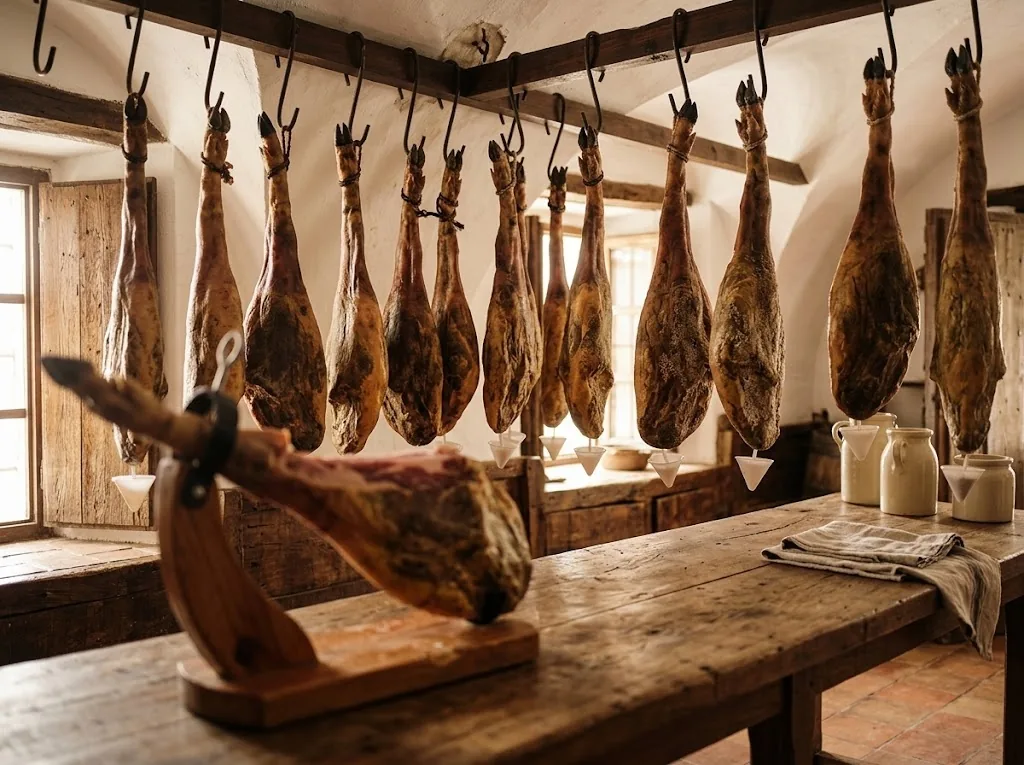
Quick answer: Pick the grade by budget (Serrano is the everyday ham, cebo de campo Ibérico is the smart upgrade, 100% Ibérico de bellota is the top tier), read the colored seal, choose bone-in for flavor and boneless for convenience, and plan roughly 2 oz of carved jamón per guest as a tapa. A 15-17 lb bone-in leg serves a party of 40 or more.
To buy a Spanish ham well, answer three questions in this order: how many people will eat it, how much you want to spend per pound, and whether you are willing to carve it on a stand. Then check the colored seal on the leg, which tells you the pig’s breed and diet by law. Everything else (brand, curing time, size) follows from those choices.
This guide walks you through each decision the way we would in a shop in Spain, with a comparison table, real price-per-pound math from our own catalog and a short checklist you can use at checkout. If you are buying online in the United States, the last section covers what to check on import, shipping and damage claims before you pay.
How much jamón do you need per person?
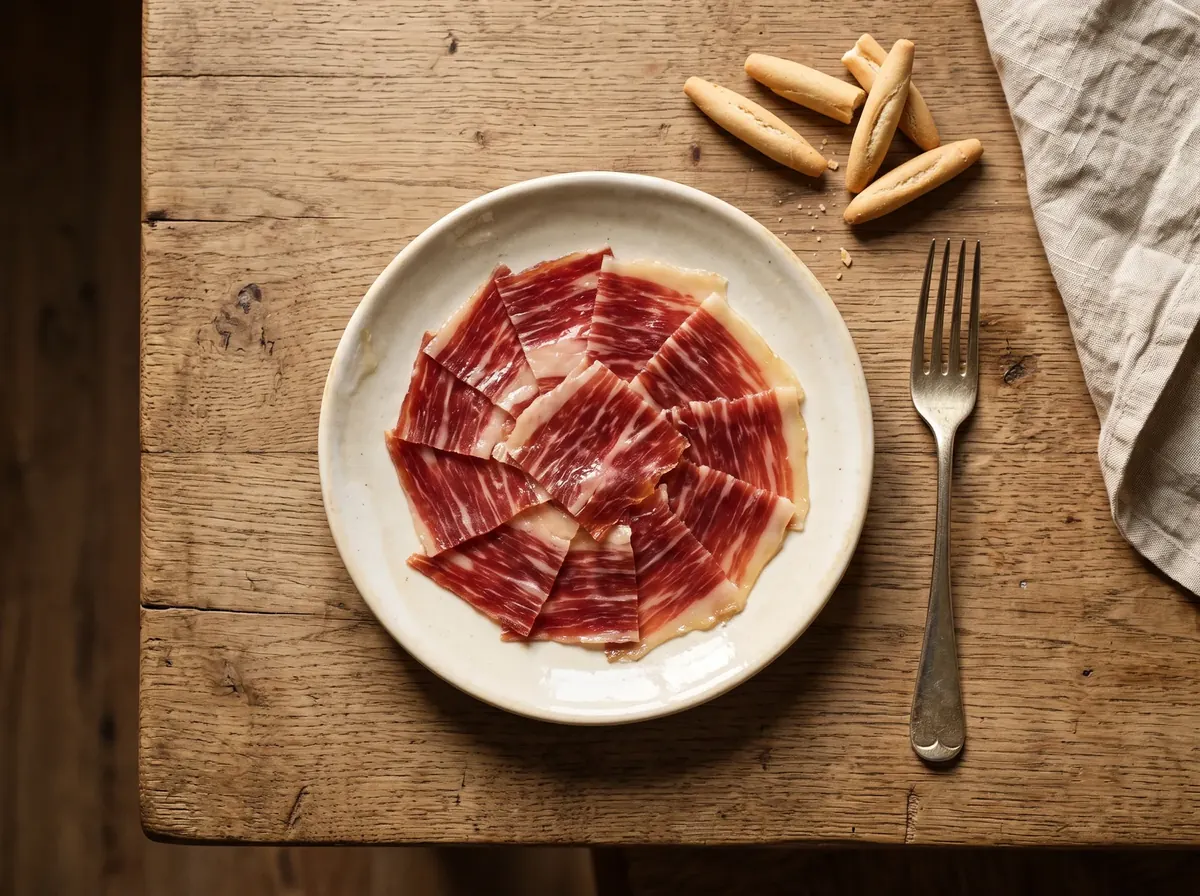
Start with the number of guests, not the ham. A whole bone-in leg is a lot of food, and it has a shelf life once you start cutting it (see our guide to storing an opened ham).
Only part of a bone-in leg is edible meat. Retailer figures put the usable portion at roughly 35 to 45 percent of the leg’s weight for hams and about 30 percent for shoulders (paletas), because the bone, rind and trimmed fat are part of the weight you pay for. Bellota hams tend toward the lower end because they carry more outer fat. The table below uses 40 percent for legs and 30 percent for paletas; treat it as a planning estimate, not a guarantee.
For serving size, our planning guideline is about 2 oz (55 g) per person when jamón is one of several tapas, and 3 to 4 oz when it is the star of the table.
| Leg type | Approx. weight | Estimated edible meat | Servings at 2 oz |
|---|---|---|---|
| Ibérico paleta (shoulder), bone-in | 9-11 lb | ~3 lb | ~24 |
| Bone-in ham | 12.5-13 lb | ~5 lb | ~40 |
| Bone-in ham | 15-17 lb | ~6.4 lb | ~50 |
| Boneless Serrano block | 4-5 lb | ~3.5-4.5 lb | ~28-36 |
| Hand-carved pouch | 3 oz | 3 oz | 1-2 (we pack it as a tapa for two) |
If you are hosting fewer than 15 people, a whole 16 lb leg is probably too much unless you plan to eat jamón for weeks. A paleta, a boneless block or pre-carved pouches are the sensible sizes.
Which grade should you buy, and what does it cost per pound?
Spanish ham comes in two families. Jamón Serrano comes from white-breed pigs and is the everyday ham of Spain: firm, salty-sweet and affordable. Jamón Ibérico comes from Ibérico pigs, a native Spanish breed, and is richer, with fat that melts at room temperature. Within Ibérico, the pig’s diet creates three tiers: bellota (acorn-fed, free-range), cebo de campo (free-range, fed grain plus pasture) and cebo (fed grain on a farm). The full breakdown, with the legal definitions, is in our guide to Ibérico vs Serrano vs Bellota.
Here is what that looks like in dollars, using our current catalog prices (October 2026) divided by the leg weight. The right-hand column estimates the price of the meat you will actually eat, using the same 40 percent yield for bone-in hams and 30 percent for shoulders.
| Product | Type | Price | Price per lb of leg | Est. price per lb edible |
|---|---|---|---|---|
| Cortijo de Canata Serrano Reserva, 13-14 lb | Serrano | $219 | ~$16 | ~$41 |
| Cortijo de Canata Serrano Reserva, 15-17 lb | Serrano | $279 | ~$17 | ~$44 |
| Beher 100% Ibérico cebo de campo, 15-17 lb | Ibérico, cebo de campo | $599 | ~$37 | ~$94 |
| Beher 100% Ibérico de bellota, 15-17 lb | Ibérico, bellota | $1,095 | ~$68 | ~$171 |
| Cinco Jotas 100% Ibérico de bellota, 12.5-13 lb | Ibérico, bellota | $1,395 | ~$109 | ~$274 |
Per-pound figures use the midpoint of each weight range and are rounded. Prices change, so confirm on the product page.
Two things stand out. First, the jump between tiers is real: bellota costs roughly four to seven times more than Serrano per pound of leg. Second, cebo de campo is the best value in Ibérico. You get a 100% Ibérico pig raised outdoors, long cellar curing and the characteristic melting fat at around half the price of bellota.
When is the splurge worth it? Bellota is for moments when the ham is the centerpiece: a wedding, a milestone dinner, a serious gift. Serrano is for sandwiches, boards, cooking and big casual gatherings. Cebo de campo sits in between and suits most households that want to taste real Ibérico.
How do you read the colored seal on an Ibérico ham?
In Spain, the seal on an Ibérico ham is not decoration. Under Real Decreto 4/2014 (the Ibérico quality norm), every Ibérico ham and shoulder carries a colored seal that tells you the diet and breed:
- Black seal: bellota, 100% Ibérico
- Red seal: bellota, Ibérico (at least 50% Ibérico breed, the percentage must appear on the label)
- Green seal: cebo de campo, Ibérico
- White seal: cebo, Ibérico
The term pata negra (“black hoof”) is reserved in Spain for the black-seal category, bellota 100% Ibérico. In practice, a black hoof alone proves nothing, and sellers outside Spain sometimes use the phrase loosely. Look for the seal and the wording on the label instead. Our label guide explains each tier in detail.
Serrano hams do not use these colors. For Serrano, look at the curing tier on the label (typically bodega, reserva or gran reserva), which reflects how long the ham was cured. Our Cortijo de Canata Reserva, for instance, is cured for 15 months.
Should you buy bone-in, boneless or hand-carved jamón?
This is where flavor, effort and budget collide.
| Format | Best for | Pros | Cons |
|---|---|---|---|
| Bone-in whole leg | Parties, enthusiasts, gifts | Best flavor and juiciness, lasts for weeks, you get the bone for stock, it is the real ceremony | Needs a stand and knife, takes practice, big commitment |
| Bone-in paleta (shoulder) | Smaller groups, Ibérico on a budget | Smaller and cheaper per pound, sweeter, still carved the same way | Less meat per bone, trickier to carve |
| Boneless block | Home cooks, sandwiches, small households | No stand needed, slice on a board, refrigerates easily | Less ceremony, shorter shelf life once opened |
| Hand-carved pouches | Gifting, instant tapas, small parties | Knife-cut by a professional, ready to serve, no waste | Highest price per ounce |
Our boneless Cortijo de Canata Serrano block (4-5 lb) is the practical choice for a household that wants Serrano without a leg on the counter. For Ibérico without the commitment, the Beher hand-carved cebo de campo pouch is a quick way to taste the difference.
In Spain, jamón carved by hand, to order, on a stand is the benchmark. A bone-in leg gives you that, and carving only what you will eat that day keeps it juicier than anything pre-sliced.
How long should a jamón be cured?
Time is part of the price. Under Real Decreto 4/2014 an Ibérico ham must be cured for at least 600 days if it weighs under 7 kg (about 15.4 lb) and at least 730 days if it weighs 7 kg or more, counted from the start of salting. The norm sets minimum weights too: 5.75 kg for 100% Ibérico hams and 7 kg for other Ibérico hams. A shoulder needs at least 365 days. Premium houses cure well beyond the minimum, often three years or more.
Serrano is cured for less time. Trade tiers are commonly described as around 9 months for bodega, 12 for reserva and 15 or more for gran reserva, although these are market conventions rather than one universal legal definition.
What do you need at home before the ham arrives?
A bone-in leg needs three things before it arrives:
- A stand (jamonero). A stable stand holds the leg while you carve. We carry the classic pine Góndola and a folding stand with non-slip pads for a sturdier setup.
- A long, flexible knife. The Arcos Niza ham knife is the classic entry point. Add a honing steel to keep it sharp.
- A cool, dry corner. Away from the stove, direct sun and radiators. Whole hams do not need the refrigerator.
See our step-by-step carving guide before the ham arrives. All our stands and knives are in the ham stands and knives category.
Where can you buy jamón ibérico in the US?
Wherever you shop, the ham has to come from the right place. Spain is eligible to export ready-to-eat, salt-cured pork to the United States, but only from plants that Spain’s food safety authority has certified for the US market. The USDA Food Safety and Inspection Service (FSIS) sets the rules and links to the list of certified Spanish plants on its Spain import page. A legal import names its producer on an English label.
Within that rule, you will find jamón ibérico in four kinds of places:
- Brand and specialty online shops. The widest choice of grades and sizes, and the easiest place to compare price per pound.
- Spanish delis in large cities. Good for tasting before you buy and for hand-carved portions.
- Warehouse clubs. Some carry jamón serrano, often around the holidays. Read the label before assuming it is Ibérico.
- Gift boxes. Handy for a first taste, but check the grade: “Spanish ham” on a box can mean Serrano.
Before you pay, check the seal and the words “de bellota” or “de cebo de campo”, the English label, and the shipping terms. The checklist in the next section goes through each one.
We carry 100% Ibérico de bellota hams and shoulders from Beher and Cinco Jotas and ship them to the 48 contiguous states. See the current sizes in our Jamón Ibérico de Bellota collection.
What should you check when buying jamón online in the US?
Buying a whole leg online is safe when the seller answers four questions clearly:
- Was it imported legally? Spanish cured pork can only enter the US from countries and processing plants approved by the USDA Food Safety and Inspection Service (FSIS), and Spain is on that list. A legal import carries an English label that names the producer and says “Product of Spain”. Every ham we sell arrives through licensed US importers.
- Are the grade and weight stated exactly? The listing should name the seal color (or the words “de bellota” or “de cebo de campo”), the percentage of Ibérico breed and a weight range, not just “pata negra”.
- How does it ship, and what does it cost? An uncut bone-in ham does not need refrigeration, so it travels by ground without ice packs. We ship within the 48 contiguous states, free on whole Ibérico hams and paletas and on any order of $250 or more; other orders pay one flat rate. Details are in our shipping policy.
- What happens if it arrives damaged? Food cannot be returned once delivered, so check how the seller handles damage. With us, you contact us within 24 hours of delivery with photos and we send a replacement or refund you. See our refund and returns policy.
Checklist before you click “buy”
- Guests counted? Match the leg to the headcount, or choose a paleta, block or pouches for small groups.
- Seal and wording checked? Black, red, green or white seal and the words “de bellota” or “de cebo de campo” for Ibérico. “Pata negra” alone is not a guarantee.
- Percentage of Ibérico stated? For anything other than 100% Ibérico, the percentage of breed should appear on the label.
- Weight range and price per pound compared? Divide the price by the weight, then by 0.4 to estimate the edible cost.
- Stand and knife ordered? Do not wait until the ham is on the counter.
- Delivery plan? A whole ham should be received by someone at home and moved to a cool spot.
Frequently asked questions
How big a jamón should I buy for 10 people?
For 10 guests at about 2 oz each, you need roughly 20 oz of edible ham. That is well below what a bone-in leg gives you, so a Serrano boneless block, an Ibérico paleta or a few hand-carved pouches fit better. Buy a whole leg for 10 only if you want to keep eating it for the following weeks.
Is a more expensive jamón always better?
Not always. Price tracks diet, breed and curing time, so bellota costs more because the pig eats acorns in the dehesa and the ham is cured for years. But a good Serrano Reserva is ideal for sandwiches and cooking, and cebo de campo delivers true Ibérico character at a lower price. Better means better for the occasion.
What is the difference between jamón and paleta?
Jamón is the hind leg and paleta is the front leg (shoulder). The paleta is smaller, cures faster (365 days minimum for Ibérico under Real Decreto 4/2014) and is usually cheaper per pound. Many Spaniards prefer its sweeter flavor, but it has less meat in proportion to the bone.
Should I buy bone-in or boneless?
Buy bone-in if you have a stand, a flexible knife and a plan to finish the leg within a few weeks. The flavor and juiciness are better. Buy boneless if you want convenience, a smaller commitment and the ability to slice on a board and refrigerate.
How long will a whole ham last after it arrives?
An uncut, bone-in ham keeps for months in a cool, dry place. Once you start cutting it, plan to finish it within 3 to 6 weeks. Our storage guide has the details.
Ready to choose your jamón?
Browse all our Spanish hams or go straight to the Ibérico de bellota hams, the cebo de campo selection and Serrano hams, or start with hand-carved sliced ham if you want to taste before committing to a leg. Add a stand and knife and you are set. If you want help picking a size, reach out and tell us your guest count and budget.